During this odd year where we have found our movements restricted I returned to a project some 16 years in the making. A project from the heart and one that would deal with emotions and dreams, life and death, fathers and sons.
At three metres wide by one metre seventy tall it is a difficult canvas to photograph in the confined space of the studio. It is an imposing piece which stands on its own as a striking image to be interpreted by the viewer. However a little background opens up the work to a more detailed interpretation.
As boys my brother and I had many questions about my father, Steve.
Yorkshire
Steve was born in 1936, the son of a formidable Yorkshire woman and an union representative for a Barnsley colliery. He was a bright child and attended a grammar school. He enjoyed mathematics, football and boxing. As a large teenager he would drink pints (and on occasion fight) with men older than himself.
Germany
By the 1950s he was serving in the RAF motor-pool as an airman based in Germany. It was here that he learnt the basics of smuggling. Along with other airmen from the base, he would take RAF vehicles across the border into the Netherlands. There they would load up on cigarettes. Utilising every cavity the cars and wagons had to offer, spare tyres, wheel arches – everywhere packed with cigarettes. Back across the border they would turn a profit.
Libya
On July 21st 1970 the Libyan Revolutionary Council issued an order to "regain wealth stolen from the Libyan people by the Italian oppressors". This began the process of expelling 20,000 Italians and 37,000 Jews from the country. An undertaking to be completed by October 7th of that year. October the 7th became a Libyan national holiday "The Day of Revenge". By the end of 1970 all foreign holdings had been seized, and almost all Jews and Italians had left the country.
Steve had arrived in Libya with his collaborators that year. Together they set about smuggling hard currency out of the country for the Jewish population. They were paid a percentage of the cash that they managed to liberate.
It was always going to be a gamble. Steve was sitting with his colleagues sorting out a table piled high with banknotes when they were raided by the Libyan special forces. A number of the "special forces" soldiers were just frightened teenagers armed with automatic weapons.
Separated from his peers Steve was interrogated. Later he was to recall some of the events to me. Under the stress of being held at gunpoint he had left his body and looked down upon the scene playing out.
"Tell us your contacts in Great Britain?"
From his high vantage point he watched as the unwelcome reply from his body came:
"Marks and Spencer"
Thud.
"Boots the Chemist"
In all he spent a year in prison in Libya. At first in a large cell with a lot of other men. Eventually he was moved to a cell with two Italian speaking Swiss. They went on to teach him Italian. The prisoners are couscous every day and, after leaving Libya, Steve never ate it again.
There are a number of stories that he eventually told me about his time in prison but I also know there were a lot left unsaid.
Birmingham
.jpg)
At the end of his life Steve suffered eight years of illness. He had faced his health issues square on and for the most part with good humour. The event depicted in the artwork occurred during this time.
Steve had been an in-patient at the Queen Elizabeth Hospital in Birmingham undergoing chemotherapy. One morning I was visiting him and he animatedly recounted the events of the night before. He had awoken in the early hours to a bright light. He rose from his bed and drew back the curtain. Directly across from him writing was burning on the wall of the ward. He did not tell me what it said but he did tell me it was written in Hebrew. It clearly had an emotional impact on him and it seemed directly linked to his time in Libya.
After he had left the hospital he had no recollection of the burning writing. I would later learn that hallucinations and memory lapses are a common side effect of Chemotherapy. After I found myself in the curious position of recounting the story to him he agreed to turn the event into a composition and set for a series of photographs and a large drawing – in his pyjamas. I think he enjoyed the day I spent drawing him, he certainly enjoyed chatting and the numerous cups of tea.
However I could not find the right composition as I kept flailing on the burning writing. The project was put on hold.
Time passed, dad passed.
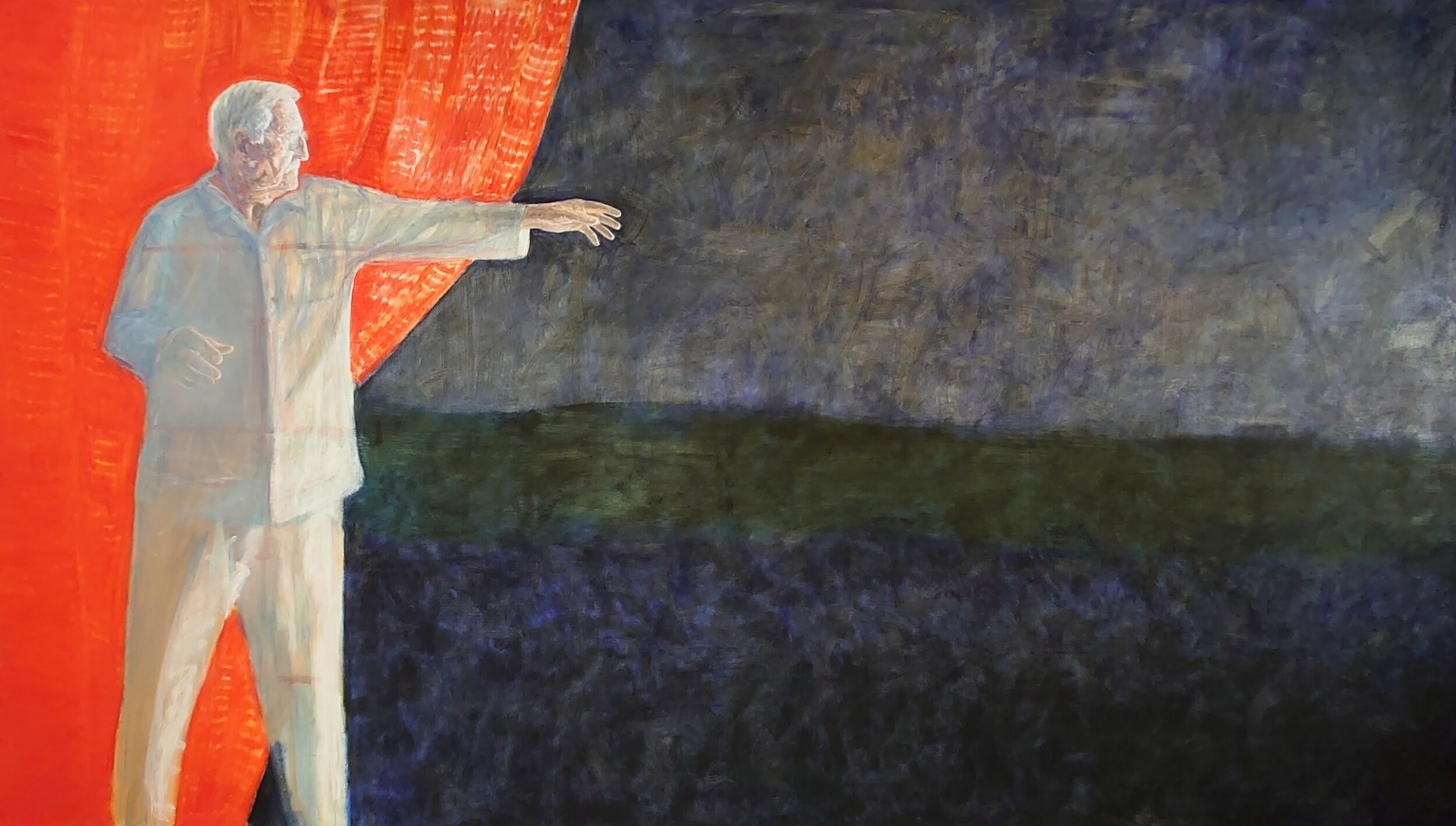
Medium: Oil on canvas (3000 x 1700 mm)
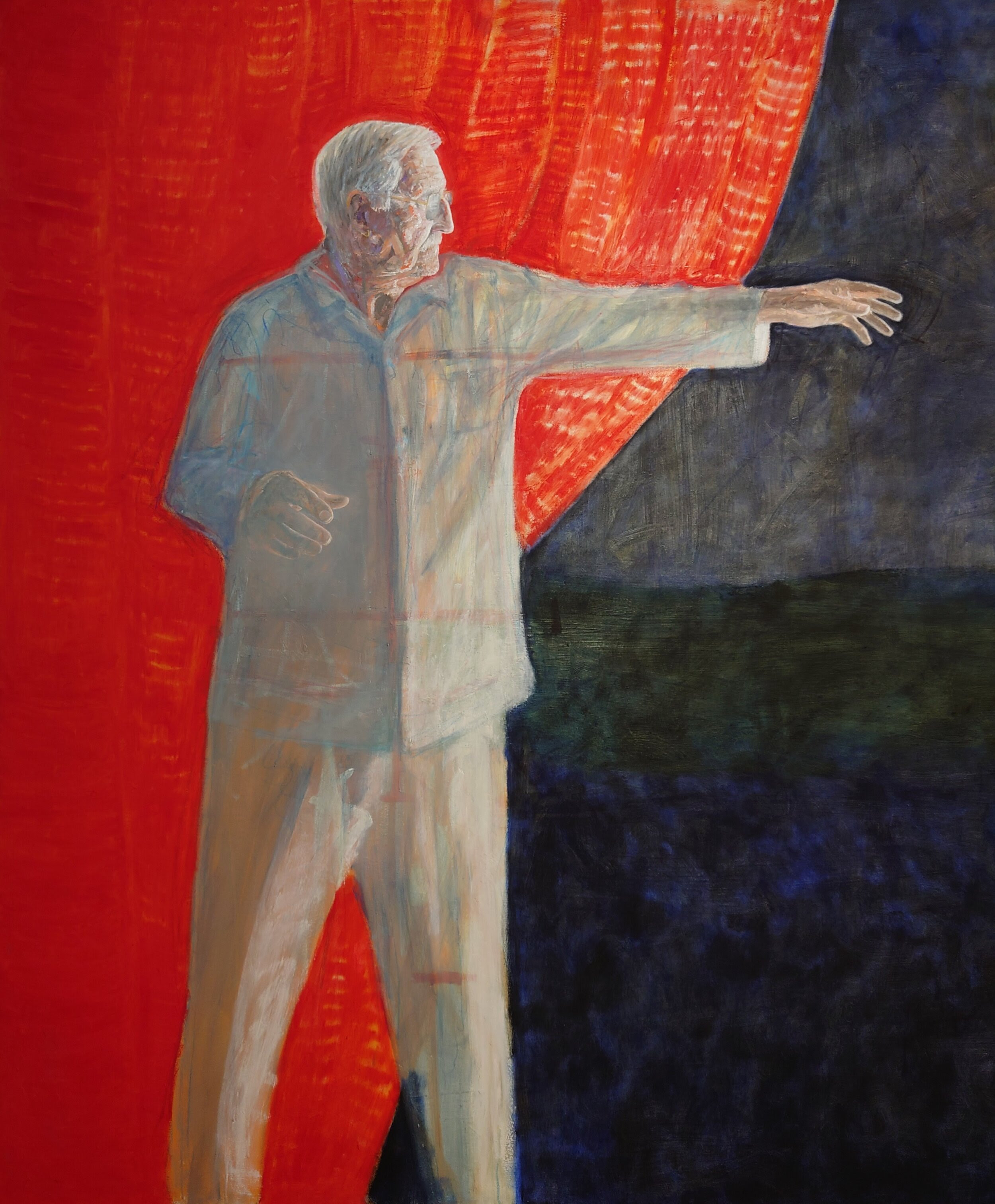
The painting holds the essence of the hallucination. Steve rising from his hospital bed, drawing back the curtain and reaching out towards the light emitted from the burning writing. It was too obvious to treat it just as an illustration however and I wanted to impart some deeper ideas.
The writing is not shown. This removed the impasse that had so stuck me previously. To balance show it would mean I would have to make a decision on what it said. I had investigated this option, talking to a friend who happens to be a Jewish alumni of Cambridge University. We had mulled over a couple of religious passages but this would be making an assumption. In the end I am very happy with the decision to leave the writing out although it is hinted at in the reflection of his glasses.
The curtain around his bed has become a kind of stage curtain from which Steve looks out to an unseen audience. He had lived his life like a main character and this felt fitting. The red also represents the warmth of living. He looks towards the darkness of death with unflinching curiosity.
Perhaps he reaches back to the past, his memories on fire.
The wall of the hospital ward has become a dark void, a deep field. There is an energy playing in the night. One hand is already breaking across the boundary as he stand astride realms. This is where the scale of the painting comes into its own. More than two thirds of the painting is the darkness. When viewing the piece it pulls, as if one could fall into it.
Steve's head and left hand are painted robustly, there is a lightness to the rest of the body. The underlying drawings and construction marks can be seen through the various oil washes. This adds a fleetingness to the moment but retains the strength of the man.
Whilst I was deep in thought painting his face a James Blunt song played on Spotify. It was a song I'd not heard before, "Monsters", a song about his father being ill. It included the lyrics:
"I'm not your son, you're not my father,
We're just two grown men saying goodbye"
It completely caught me off guard. Painting this piece has been like spending time with and saying goodbye to my father once more. It is the most emotionally honest artwork I have created to date.
I hope my father would have been proud.
DRM